|
Biological Science
The Etiwanda Fan
The Etiwanda Fan is located in the southwest corner of San Bernardino County California in the foothills of the San Gabriel Mountains and north of the City of Rancho Cucamonga.
Bark
Beetle
California is currently experiencing an outbreak of bark
beetles.
Mission Statement
The Biological Science Division is a major resource center
for the public and for scholars. The mission of the Biological
Science Division is to acquire, conserve, investigate, and
interpret the natural heritage of California and southwestern
North America. Through research, collections, education,
and public exhibits, the Biological Science Division serves
the state, national, and international sciences programs.
Biological Science holds approximately 198,000 biological
specimens in entomology, herpetology, ornithology, mammal,
and botany. The collections are strong in species native to
western North America, although some collections contain
specimens from Asia and Central America. The division is in
the process of cataloging all specimen records in a computer
database.
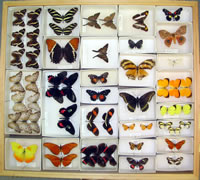
Entomology Section
The Entomology collection holds over 25,000 specimens,
primarily insects. This collection is representative of
San Bernardino County and Southern California, with some
specimens from the western United States. The collection
is under the care of Eugene A. Cardiff, Emeritus Curator.
Alexander Sokoloff Collection
includes:
Tribolium Information Bulletin - complete collection
Biology of Tribolium - all volumes
Mutant Type Specimens for Tribolium sp.
Reprints of Alexander Sokoloff literature publications
Bark
Beetle
California is currently experiencing an outbreak of bark
beetles.
Herpetology Section
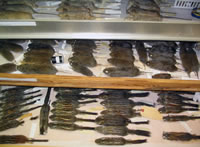
The Herpetology collection holds approximately 9,000 native
reptiles and amphibians (dry and fluid-preserved whole specimens),
principally from the southwestern United States, and a small
collection of exotic reptiles from various parts of the
world.
Ornithology Section
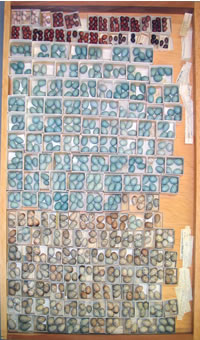
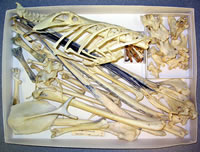
The Ornithology collection holds approximately 148,000
bird skins, bird eggs, live mounts, and osteological specimens.
The bird egg collection is the fifth largest in the world.
It was amassed mostly between 1910 and 1940 by Wilson C.
Hanna, an oologist (collector of bird eggs) and a loose
army of private collectors , with a handful of practitioners
persisting until 1960. The collection has world-wide components.
Eugene A. Cardiff, Emeritus Curator of Biological Science
Division was instrumental in developing, and curating this
significant collection into the 1990s.
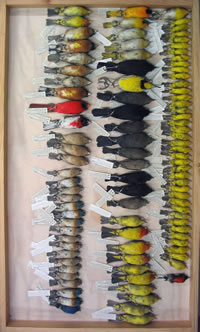
The bird skin research collection holdings are approximately
48,000 with material from throughout North America with
a major portion of the collection representing western North
America. The Biological Science division also maintains
more than 1000 live mount birds.
Mammalogy Section
The Mammal collections holds approximately 500 specimens
representative of San Bernardino County and Southern California,
with some specimens from western United States.
Botany Section
The herbarium houses nearly 10,000 specimens of native
plants of the southwestern United States, primarily southern
California. The collection consists mainly of vascular plants.
Contact: (909) 307-2669 ext. 263 / TDD/TTY: (909) 792-1462.
Permanent Collections Access and Use Policy and Procedures
|